Water and Energy Platform submits proposals to Lula’s government plan coordination team
The document presents proposals for energy policy and advocates for the renationalization of strategic companies, state price controls, and the protection of the rights of workers, energy and water consumers, and those affected by construction projects in the sector
Published 25/09/2026 - Updated 25/09/2026
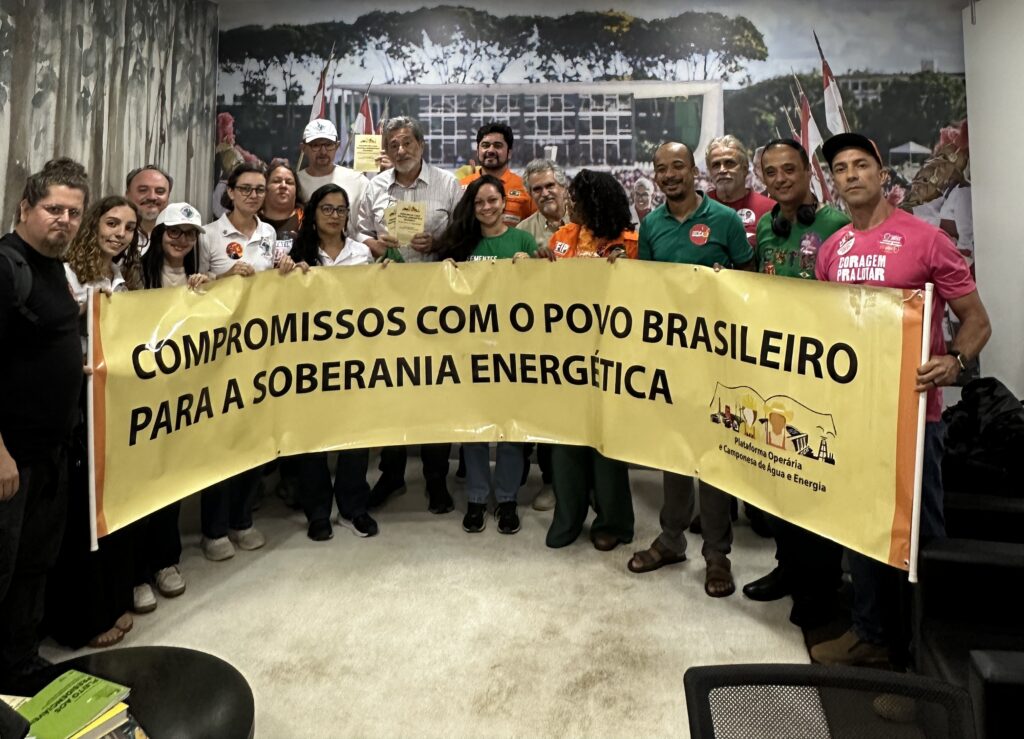
Engineers, electricians, oil workers, energy experts, urban organizations, and groups representing those affected by dams—all representatives of the Workers’ and Peasants’ Platform for Water and Energy—presented the document “Proposals for a National Energy Policy—Brazil for Brazilians” this Thursday (24) in Brasília. The document was presented directly to economist José Sérgio Gabrielli, former president of Petrobras and coordinator of the government platform for Luiz Inácio Lula da Silva’s presidential campaign.
The document presents 10 pillars for a profound reform of the country’s energy and water sectors, organized into five major thematic blocks that advocate for national sovereignty; the strengthening of public enterprises with state control over prices and rates; the reindustrialization of the country through a just energy transition and the development of indigenous technology; and the protection of the rights of workers, consumers, and communities affected by large-scale projects, as well as adequate environmental sustainability and prevention of extreme weather events.
When receiving the document, José Sérgio Gabrielli, general coordinator of the government program for President Luiz Inácio Lula da Silva’s (PT) reelection campaign for the 2026 elections, highlighted the importance of the contribution made by the organizations that make up the Water and Energy Platform, which includes various entities operating in strategic sectors and responsible for energy and water supply, as well as for defending key segments and organizations of the Brazilian people, in the development of a sovereign program for the next mandate.
“I have just received the proposal from the Workers’ and Peasants’ Platform for Energy, which offers significant contributions and insight into the issues from the perspective of workers and the Brazilian people. Therefore, it is with great honor that I have just received this document, and we will incorporate and explore the possibility of utilizing these contributions in President Lula’s government platform,” Gabrielli emphasized.

The delegation that delivered the petition included about 15 national leaders from organizations and movements that make up the Platform, including the United Federation of Oil Workers (FUP), the National Confederation of Urban Workers (CNU), the National Federation of Urban Workers (FNU), the Interstate Federation of Engineers’ Unions (FISENGE), the Movement of People Affected by Dams (MAB), the Small Farmers’ Movement (MPA), the Popular Peasants’ Movement (MCP), and the National Confederation of Education Workers (CNTE), with the monitoring and support of the Unified Workers’ Central (CUT), the Central of Popular Movements (CMP), and the Union of Housing Movements (UMM).
According to Gilberto Cervinski, an energy expert and national leader of MAB, the meeting aimed to present the key issues on which the Platform is united in order to improve national energy policy.
“Brazil has great potential, and the Brazilian people should benefit from everything produced in the areas of water, energy, oil, and other minerals,” Cervinski stated, and he emphasized “the urgency of investments in science, technology, and the distribution of wealth”.
For Fabíola Latino Antezana, vice president of Energy for the National Confederation of Urban Workers (CNU) and leader of the Federal District Union of Urban Workers (STIU-DF), submitting this document to President Lula’s campaign coordinator is a strategic move, given the country’s international standing on the issue of the energy transition and the direction in which public policies for this sector have been heading.
“We need to bring a more grassroots perspective and a stronger social focus to these public policies, so that a people-centered and sovereign energy plan is included in a future Lula administration. The CNU advocates for a state-owned electricity sector to manage the energy transition process, the renationalization of all assets in the energy and sanitation sectors, and respect for the territories and people in the areas where these projects are implemented,” Fabíola noted.
Cibele Vieira, general coordinator of the United Federation of Oil Workers, believes that natural resources must benefit Brazilian society. “We have to consider those affected by the work we do and determine what purpose the proceeds of what we all generate are serving. In this regard, we are discussing the distribution of the wealth generated as well as the allocation of resources, which can be used for health and education and to attract investments to overcome the population’s energy poverty,” she argued.

In addressing environmental sustainability and the fight against the climate crisis caused by the capitalist model of production, the Platform expressly rejects the privatization and commodification of forests and water resources, advocating for the state to lead the energy transition process.
Among the document’s proposals, the creation of a fund financed by taxes on extraordinary profits from oil and gas companies to finance decarbonization, climate adaptation, and social reparations also stands out.
Representatives of the Platform viewed the reception by the Coordinator of President Lula’s government program as positive and expressed the need to continue the dialogue so that the future national energy policy becomes a central element for a high level of development, with wealth distribution and environmental sustainability.
Check out the full document below:

Plataforma da Água e Energia lança propostas para Política Energética Nacional