
Artist Hilda Souto writes about the arpilleras of the affected women in Brazil and highlights that “by embroidering together, these women produce a collective body of resistance, an aesthetic and political community that recognizes itself in pain, but also in the power of creation
Published 21/10/2025 - Updated 03/11/2025

As we approach COP-30 — the Conference of the Parties —, an event that Brazil will host in Belém, in the state of Pará, from November 10 to 21, 2025, world leaders will gather to discuss issues related to climate change. It will be the first time Brazil has hosted the conference, and the first time a COP event will take place in the Amazon region.
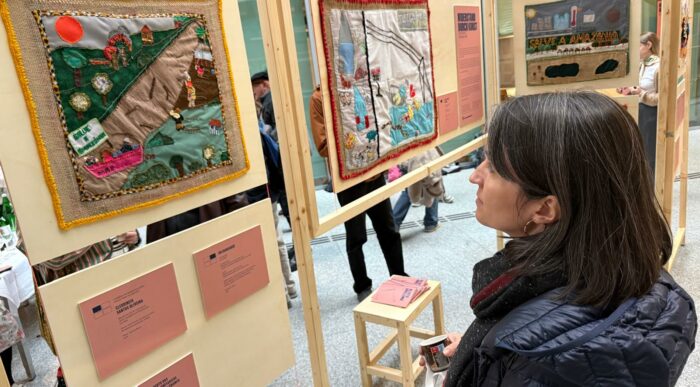
Concurrently with this meeting, an exhibition of arpilleras by MAB will take place in Salzburg, Vienna, from October 2025 to April 2026. The catalog presents the exhibition and its connection to the event that will occur in Belém:
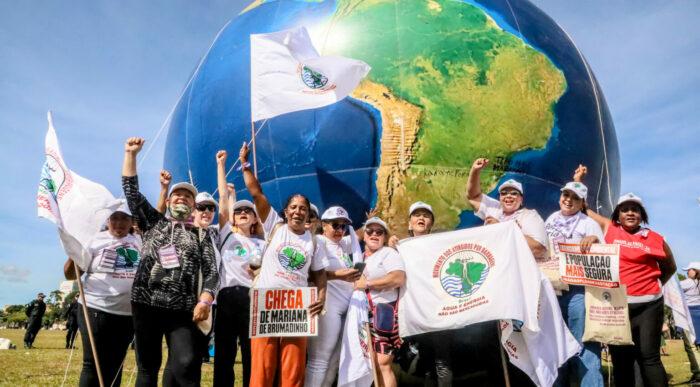
“Alert Amazon! — When the Fabric Speaks” brings arpilleras, wall tapestries intricately embroidered in patchwork, from the Brazilian Amazon region to Austria. The exhibition shows how this unique textile art, originating in Chile as a means of resistance during military dictatorship, found new and powerful meaning in the Amazon. The Brazilian organization MAB (Movement of People Affected by Dams) is responsible for the exhibitions. For over ten years, the women of MAB have used the arpillera method to tell their stories. Each piece is a testimony of resilience, resistance, and hope. They show the stories of women who process their experiences with climate change, environmental destruction, and resource exploitation, making their struggle for survival and community visibility.
It is moving to perceive how artisanal craft transformed into a language of resistance recognized worldwide. It is not uncommon that, in the shadow of authoritarian regimes or contexts of oppression, art finds cracks through which to breathe. Some write from prison, others draw, paint, or compose; there are also those who embroider, stitching stitch by stitch what censorship tries to silence. Artistic languages, in these moments, become shelter and voice. Arpilleras are vital forces: they sustain women and their families, nourish their struggles, and prolong the cry for a dignified life when words are insufficient.
Embroidery becomes manifesto. As they embroider together, these women produce a collective body of resistance, an aesthetic and political community that recognizes itself in pain, but also in the power of creation.
There is still what we might call a poetics of testimony. Arpilleras bear witness. They are fragments of interrupted life, stitched together like someone trying to mend torn social fabric. Each stitch contains an attempt to say the unsayable, to inscribe in the visible that which official discourse wishes to erase. In the context of MAB, arpilleras are both an act of remembrance and an act of struggle. They not only commemorate the losses caused by dams — homes, rivers, stories — but also announce another possibility for the future. When exhibited, shared, and recognized, these works become goods of community memory, because they belong not only to the embroiderers, but to all people who see themselves reflected in the resistance they narrate.
Arpilleras, in contemporary Brazilian art, constitute an aesthetic and political territory where art ceases to imitate and begins to act. They manifest themselves in the manner of making, in the matter chosen, and in the relationship with the public, turning the work into a place of encounter and social reinvention. Thus, they are anchored in concrete reality, a reality of inequality, but also of poetic invention. By incorporating this dimension, arpilleras reiterate art’s vocation as a place of transformation: a living space, unfinished and profoundly human.
I wish to express my gratitude to Maria Madalena Andrade de Oliveira, Claudete Almeida Costa, Lucielle de Sousa Viana, and Claudineia Santos Oliveira, who lent us their talents to carry across the ocean the desire of all Brazilians to see our forest respected — a common good that, if destroyed, will affect everyone, without exception.
- Hilda Souto is Visual artist, designer, and professor. Currently researches Brazilian art in dictatorial contexts.